
What a Connected Cash Operation Actually Looks Like
For many businesses, cash operations are still managed as a series of separate activities.
Cash is collected at the location. Deposits are prepared. Armored pickups are scheduled. Banks process deposits. Managers reconcile activity. Finance teams review reports. Service issues go to one provider, hardware issues to another, and questions about deposits or credit may involve someone else entirely.
Each part may work on its own. The problem is that the operation rarely works as one connected system.
A connected cash operation brings those pieces together, giving teams better visibility, fewer manual processes, and a clearer picture of what is happening across the entire cash lifecycle.
It Starts Where Cash Enters the Operation
The process begins at the point where cash is collected.
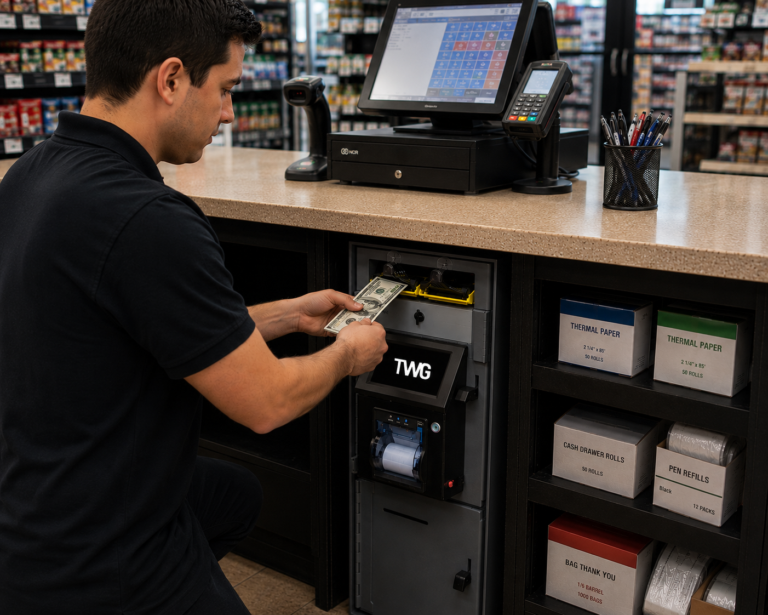
Depending on the business, that could mean a traditional cash drawer, smart safe, cash recycler, self-service kiosk, ATM, or another cash-handling device.
Modern cash automation can do much more than secure money. It can capture transaction and deposit data at the source, creating the foundation for everything that happens next.
But the hardware itself is only one part of the equation.
Cash Data Becomes Operational Data
Once cash activity is captured digitally, businesses can begin replacing manual reporting and disconnected spreadsheets with centralized visibility.
Instead of waiting for reports from multiple locations or logging into several provider portals, operations and treasury teams can see activity across the network in one place.
That may include:
Deposits by location
Cash balances
Pickup activity
Device status
Exceptions and discrepancies
Settlement or credit status
Historical trends
The result is a more complete view of the operation rather than individual snapshots from separate providers.
Banking, Logistics, and Technology Work Together
Cash ultimately has to move through several different systems.
A carrier may transport it. A bank may provide provisional credit or settlement. Hardware captures the transaction. Software provides reporting. Internal teams manage exceptions.
In a disconnected environment, the customer is often responsible for coordinating all of those relationships.
A connected model allows those systems and providers to exchange information more effectively, creating a workflow that is easier to manage and easier to scale.
That is where open integrations become especially important.
Rather than forcing an organization into one bank, one carrier, one hardware manufacturer, or one technology platform, an open architecture can connect the partners and systems already supporting the business.
Cash Movement Becomes More Predictable
Better visibility also makes it possible to manage cash more strategically.
Instead of following fixed schedules or reacting to individual locations, teams can use operational data to understand where cash is accumulating, where it is needed, and when movement should occur.
That can support better decisions around:
Pickup frequency
Cash inventory
Replenishment
Forecasting
Working capital
Location-level performance
For large organizations, even small improvements across hundreds or thousands of locations can have a meaningful operational impact.
Exceptions Are Managed, Not Just Reported
Every cash operation eventually has exceptions.
A pickup is missed. A device goes offline. A deposit does not match. A location has too much or too little cash. A settlement requires investigation.
Technology can identify these issues, but visibility alone does not resolve them.
A truly connected operation also includes the processes and people required to manage exceptions across banks, carriers, hardware providers, and locations.
That means fewer handoffs, clearer accountability, and less time spent figuring out who owns the problem.
From Individual Products to One Operating Ecosystem
The goal of cash automation is no longer simply to install better hardware.
It is to create an operating environment where cash, data, technology, logistics, banking, and service work together.
At The Wave Group, that is the idea behind a connected financial operations ecosystem.
WaveAtlas provides the hardware layer. Insight creates visibility across the operation. WaveCore connects systems and partners through an open architecture. WavePlus adds ongoing managed services and operational support. And TotalWave brings those capabilities together into a more comprehensive operating model.
Organizations can use the pieces they need without being forced to replace the systems and partners that already work for them.
Because the future of cash management is not about adding another product.
It is about making the entire operation work better together.
Ready to take a closer look at your cash operation?